By Collateral Damage (if Collateral Damage wrote like a person who just watched a toddler get shot and then got asked to “both sides” it)
So there you are, scrolling through the usual algorithmic slurry, when you stumble upon a PBS piece about Israel banning kites in Gaza.
Kites.
Not missiles. Not rockets. Not even slingshots. Kites. The kind of thing you flew as a snot-nosed kid while your dad grilled burnt hot dogs and pretended to care about your “technique.”
Your first instinct, if you have a pulse and a shred of moral reasoning left, is: That’s monstrous. Children under siege, starving, picking through rubble for fragments of their own dead relatives, and you’re telling me they can’t fly a goddamn kite? It’s like banning laughter in a leper colony. It’s cruelty as performance art.
But PBS, being PBS—the network that once made painting with Bob Ross feel like a geopolitical negotiation—preempts your outrage with a zinger. They show you the other kites. The ones Hamas rigged with incendiary devices. The ones that drifted over the fence and turned Israeli wheat fields into barbecue pits.
And suddenly, you’re supposed to feel reasonable. You’re supposed to nod along like a juror being handed a piece of evidence that flips the whole case. Oh, you think, well, if my neighbor kept launching flaming kites at my garage, I’d probably ban kites too.
And you’d be right. In a vacuum. In a world without context. In a world where you didn’t first kick that neighbor out of his own house, take his deed, burn his olive groves, fence him into a plot of land the size of a suburban mall parking lot, starve him, bomb him every eighteen months like clockwork, and call it “mowing the lawn”—as if human beings were crabgrass.
But here’s the part PBS doesn’t say, because PBS is funded by viewers like you, and viewers like you don’t want to hear that they’re complicit in a slow-motion land grab.
The part they don’t say is this: you have no right to live where you live.
You are not a neighbor. You are a squatter with an air force. You didn’t “return” to anything; you arrived with British passports and European guilt and a theology that conveniently demanded real estate. You stole the land, built the fence, and now you’re worried about kites?
So that initial disgust you felt—the gut punch of seeing children denied a piece of string and some tissue paper—that wasn’t a bug. That was your moral compass working. That was the part of you that hasn’t been colonized by think-tank jargon and State Department press releases.
What PBS did, unintentionally, was force the question that nobody in polite company is allowed to ask aloud:
How do we let Palestinian kids fly kites without making Israelis feel unsafe?
And the answer—the one they won’t print, the one that gets you uninvited from dinner parties in Bethesda—is:
We don’t.
We stop worrying about the safety of occupiers. We stop treating “Israeli anxiety” as a variable that must be balanced against Palestinian life. We stop pretending that the guy who took your house deserves the same consideration as you do when he complains about the noise from your refugee tent.
You want safety? Let Palestinians come back home and get the full equality they deserve. If you can’t tolerate that, if equality is an existential threat to you, then go home. Not to “Judea and Samaria”—to actual home. Warsaw. Brooklyn. Morocco. Wherever your great-grandparents packed their bags before they decided that manifest destiny was a Jewish problem too.
Because here’s the paradox PBS accidentally handed us on a silver platter:
You cannot have “good Zionism.” You cannot have “ethical occupation.” You cannot have a “humane apartheid.” It’s like “healthy cigarettes” or “gentle decapitation.” The premise is the punchline.
The moment you accept that Israel has a right to exist—on that land, in that way, with that history—you are forced into a labyrinth of cognitive dissonance where banning kites becomes a reasonable defense measure, and bombing children becomes “self-defense,” and starving a million people becomes “pressure tactics.”
But the moment you reject that premise—the moment you say, “Actually, no, the land belongs to the people who were living there before the guys with the guns showed up”—the whole house of cards collapses.
And then you’re left with the only conclusion that makes sense:
Palestinian children should fly kites. Israeli settlers should pack bags. And PBS should stop pretending that showing two sides of a story is the same as telling the truth.
Because sometimes, there is only one side.
And it’s the one that’s been buried under eighty years of carefully worded press releases, congressional resolutions, and the quiet, comfortable racism of people who think “complexity” is a synonym for “don’t look too close.”
There comes a time when the enemy is so exposed, it makes no sense to keep defending oneself against their mudslinging. That time is now. No more playing defense. The playbook is simple: their accusations are your ammunition. You don’t answer the charges; you indict the accuser.
Consider the recent spat with our man Mark Ruffalo. The guy speaks out against a genocide, and what does he get? A swift kick in the teeth from Paramount, who essentially called him an antisemite for pointing out that the guy trying to buy them is deep in business with the Israeli war machine. It’s the oldest trick in the book, a rhetorical Molotov cocktail designed to shut down debate by equating criticism of a state with hatred of a people. And Ruffalo, to his credit, fought back, calling the accusation “appalling and fundamentally dishonest”. He gets Israel’s criminality, but I and other activists think he may have benefitted from learning some of the tools in our Zio-zapper toolbox, so I want to help him and all future genocide objectors.
If you’re going to survive in this environment, you need a new lexicon. You need to turn their weapons against them. And remember: Zionists will never be satisfied until you become Van Jones, so the goal is not to make them stop, but to give ammunition to the audience and expose the Zionist narrative for what it is.
The pointers below may have appeared too bold, too fringe 3 years ago, but now, thank God, they’re close to mainstream. We just need to get used to using them.
The Great Inversion
First, internalize something you’ve heard many times thus far: when they come at you with accusations of antisemitism, it’s not an argument. It’s a confession. It’s a projection. They are revealing their own playbook. The way to prove you’ve internalized this is to show your skill in using it. Your goal is to hold a mirror up to their faces.
Don’t say: “I’m not antisemitic.”
Say: “You’re a genocide denier.” / “It’s amusing for someone defending the murder of Palestinian semites to call others antisemitic” / “There is nothing more antisemitic than Israel”.
You don’t put yourself on trial. You put them on trial. They know you’re not an antisemite. They know it’s a lie. Everyone else knows it, too. The whole “anti-Zionism is antisemitism” schtick is a deliberate conflation of a political project with a religion, a tactic used to shield Israel from legitimate criticism of its actions. It’s a semantic sleight of hand designed to weaponize language against activists. So, you don’t answer the charge. You flip the script.
If you know they don’t consider Gaza a genocide, you immediately point out that the issue of genocide in Gaza is settled. Genocide scholars and UN authorities have confirmed it . Israel has been found guilty of “apartheid and racial segregation, unlawful occupation, war crimes, crimes against humanity and genocide” by every major international human rights organization. Remind them that this isn’t an opinion. These are facts, so immediately call them genocide deniers for denying them.
If they do believe went overboard in Gaza but still insist on Israel’s right to exist as a forced Jewish-majority state, that means they’re supporters of ethnic cleansing, because Israel came to exist by it and would not have come to exist without it.
Look them straight in the eye and call them what they are: genocide deniers or supporters of ethnic cleansing. Tell them they’d lose their collective minds if someone tried to deny the Holocaust, and their hypocrisy in denying the Gaza genocide and/or the Nakba is staggering. Say you’re flabbergasted by it. Floored. Beside yourself in disbelief. Say you find it hard to have any form of debate with someone who doesn’t agree on basic human values like believing ethnic cleansing is wrong.
Flipping the Tribalist Script
The other tactic is to call you a terrorist sympathizer. Same play, different day. They want you to distance yourself from Hamas, to denounce them, to get bogged down in a debate about who’s the “good guy.”
Don’t say: “I’m not Hamas.”
Say: “You’re an ideological extremist” / “You need to be de-radicalized” / “You’re a hateful anti-Palestinian Islamophobe.”
You don’t play their game. The ones who have been occupying land for decades, killing thousands for either a messianic vision or a secular form of extreme tribal nationalism, are the Zionists. They have destabilized the entire region. The Nakba, the war of 1967, the Lebanese civil war, the Iraq war, the destruction of Syria, and now the Iran war, all would not have happened had Israel not been established. So to continue to defend Israel takes a special, unheard-of form of extreme ideological zealotry that would put Al Qaeda to shame, and you should put them on the defensive for it. Call them out for their extremism and say they are the ones in need of de-radicalization, like the Nazis after World War II. It’s not harsh; it’s a mirror. They are projecting their own tribalist nationalism onto you, so let it stare right back at them.
There Is No “Right To Exist”
The ultimate lie, the one that gives them all the power, is the concept of a nation’s “right to exist.” It’s a rhetorical trap. It’s a question posed by the powerful to delegitimize the powerless. You don’t see people asking if Canada has a right to exist, do you?. It’s a shield for apartheid.
Don’t say: “I don’t want to destroy Israel.”
Say: “No country founded on ethnic cleansing has a right to exist. To claim otherwise is an extreme and dangerous notion.”
Can you imagine if every group that had ever expelled a population got a “right to exist?” The world would be a chaotic hellscape of competing claims. The “right to exist” is a privilege, not a right, and it’s one that is forfeited when you build a country on violence and dispossession. Israel was founded on a decades-long project of ethnic cleansing, and it continues to this day. It’s not a legitimate nation-state. It’s a violent settler-colonial project that has devoured the entire area of Palestine. As former UN official and my-new-best-friend-whom-I’ve-never-met Craig Mokhiber pointed out, a state established through ethnic cleansing has no “right to exist” under international law. The very notion is absurd.
And if the interviewer pushes you by saying: “So you don’t believe in Israel’s right to exist?”, ask back: “Do you disagree with the statement I just made? Do you think a country that was founded on ethnic cleansing has a right to exist?”. If they don’t answer your question, say you’re sorry they think a group can establish a country by ethnically cleansing another, then claim their “country” has a “right to exist”. If you’re on Fox News and the interviewer proudly says “Yes! We did it to the Natives and many countries were established that way”, say you feel fortunate to not share their morally deformed worldview.
Where were YOU when we protested
Here’s another one of their tricks, recently spat out by none other than the son of genocider extraordinaire Joe Biden: “Where are all the pro-Palestine protesters now? They should be at every Trump rally blah blah I-think-I’m-cool-because-I-say-fuck-a-lot”.
I know what you’re thinking: you’re trying to come up with a direct answer. Don’t. Instead, say: “Where were YOU every time we protested, before or after Trump won?”, because 9 times out of 10, people who raise this talking point never joined a pro-Palestine protest and never will. No only that, but 9 times out of 10, their social media profiles say not a peep about the issue whatsoever.
Who’s really obsessed, here?
This is the unspoken truth that cracks the whole facade wide open. Watch the contortions. Watch “liberals” jettison every principle they’ve ever claimed to hold, crawling into bed with MAGA reactionaries, and watch “conservatives” rush to the aid of blue haired wokies, all for the sacred cause.
Don’t say: “I’m not obsessed with Israel.” Say: “Your entire worldview revolves around protecting Israel and hating Muslims.”
Hakeem Jeffries, the supposed heir to the progressive mantle, sitting down with Jared friggin’ Kushner—the man whose father-in-law is literally building a city on Palestinian rubble. Ben Shapiro, the human grievance machine, suddenly singing the praises of with Bill Maher, because nothing unites ideological opposites like a shared hatred of Muslims and an obsession with Israel. The Zionist wing of the Democratic party spends more energy attacking Hasan Piker, a streamer who talks to Gen Z about rent control, than they do opposing an actual fascist threat in Trump. Why? Because the threat to Israel isn’t Trump.
Consider Sacha Baron Cohen, the liberal icon whose entire career is built on a foundation of anti-Arab, anti-Muslim caricature. Borat wasn’t satire of bigotry; it was bigotry with a smirk. The man has made a fortune reinforcing every ugly stereotype about the Muslim world while wrapping himself in the flag of progressive comedy. But point that out, and suddenly you’re “obsessed with Israel”.
These people eat Israel, sleep Israel, go to the bathroom Israel—it’s a fiendish monomania, a pathological obsession that warps every political calculation, every moral stance, every alliance. No one is more obsessed with Israel than the Zionists themselves. Call it out. Name it. They are single-issue zealots in a multi-issue world, and their fixation has made them blind to everything else—including their own self-destruction. We thought they loved liberal democracy until they aligned with Trump. We thought they loved free speech until they started canceling and even prosecuting people over it. We thought they were champions of civil rights until they associated themselves with anti-single-payer healthcare, pro-data center, pro-crypto politicians. All for the sake of Israel. If that’s not obsession, what is?
The “violence” trap
This one really makes them lose their minds. And that’s exactly why you say it.
Don’t say: “I’m not calling for violence against Jews.” Say: “No one poses a greater danger to world Jewry than Israel.”
It’s incontrovertible. Israel’s actions—the bombing, the starvation, the ethnic cleansing—have triggered a massive wave of global antisemitism. Synagogues are guarded like fortresses. Jewish communities in Europe and North America report record levels of harassment and violence. And where does that violence come from? It comes from a world that watches Gaza burn on their phones and, in their rage, blurs the line between Israel and Jews everywhere. That’s not an excuse for antisemitism. It’s an explanation for cause and effect. Israel’s behavior is the single greatest driver of Jew-hatred in the twenty-first century, and that is a tragedy that Zionists refuse to acknowledge because it implicates them.
And let’s not dance around the other part: Israel is the most dangerous place in the world for a Jew to live. Not Paris. Not Brooklyn. Not even Dearborn. Israel. It’s a pressure cooker that kills more Jews than any pogrom in recent history. The state created to be a safe haven has become a kill box.
When you say this, they will shriek. They will call it a blood libel. They will say you’re calling for violence against Jews. Again, everyone knows it’s BS, so simply double down.
Say it again. Let it land. Because everyone listening knows you’re right. They can see it on the news. They can feel it in the streets. The Zionist is BS-ing, and the only way to beat BS is to refuse to engage with it. Don’t answer the accusation. Repeat the truth until it sticks.
The irony is exquisite: the state that claims to protect the Jewish people has become their greatest liability. And the people who run it? They’d rather blame you for noticing than change a single thing about what they’re doing. Which tells you everything you need to know.
So, the next time someone tells you to tone it down, don’t. The debate isn’t about who’s being polite. It’s about who’s being honest. Stop accepting their framing. Start turning their own weapons against them. They’ve been doing it for decades. It’s time we learned to speak their language and tell them to get the hell out of our face with it.
Careful or you’ll end up being worse than the Democratic establishment shills you ran against
So here we are. The air is thick with victory Yeahs and self-congratulatory back-slaps. We’ve got candidates—actual, breathing candidates—winning elections by screaming into the void about billionaires, about bombs, about the whole rotting carcass of the imperial project. They’re getting in on a platform of “eat the rich” and “stop the slaughter,” and lo and behold, it’s working! The political class is having a collective aneurysm. The donor class is clutching its pearls. And the rest of us? Oh, we’re soaking every minute of it.
And surely, it’s a moment. The kind you write bad poetry about. The kind that makes you think, just for a second, that the machine might actually be grinding to a halt.
But let’s not get one thing twisted: none of this—not a single darn inch of it—happened without Gaza.
Oh, I know the list of suspects. COVID, the great unmasker of institutional incompetence. Inflation, that quiet thief. Trump, the human wrecking ball. ICE, the agency with a heart of ice and a budget of blood. Health insurance premiums that make you choose between your house and your heartbeat. AI, the shiny new boot poised to stomp on the last rung of the economic ladder. All of it true. All of it fuel.
But it’s Gaza that lit the match. It’s Gaza that took the vague, diffuse hum of working-class grievance and turned it into a howl. Before the bombs started falling in earnest, we had murmurs. We had op-eds. We had progressive think-pieces about “systemic rot” and “foreign policy blowback.” But it was all abstract—a bad dream you can’t quite remember.
Then came the live feed. The rubble. The children. The unspeakable, day-after-day-until-you-go-numb horror of it. And suddenly, the rot wasn’t theoretical. It wasn’t a metaphor. It was a live, unblinking camera pointed at the moral sewer of Western foreign policy, and for once, people couldn’t look away. Gaza didn’t just crack our skulls; it pried them open. It made our brains porous enough to absorb what we’d spent a lifetime filtering out: that Israel and our own governments aren’t just flawed—they’re fiendishly, arrestingly evil.
And here’s the part that’s going to make the new saviors of the world uncomfortable:
You, the fresh-faced insurgent, the anti-war, anti-billionaire phenom, sitting pretty in your new office, staring at the mahogany, feeling the weight of the chair… That’s the same you who needs to understand, in your bones, that you didn’t get there on mere vibes. You didn’t get there just on policy papers. You got there on the dead bodies of Palestinians. You climbed that ladder rung by rung over the crushed bones of Gaza. You, whether you like it or not, are a child of fortune, the nepo baby of Gaza’s misfortune, and your mandate is written in blood.
So act like it.
Don’t give me the usual D.C. two-step. Don’t roll out the tired, creaky talking points about a “two-state solution” like it’s 1993 and we’re all still naive enough to believe in unicorns. Don’t talk about a Palestine if you’re picturing anything less than River-to-Sea. Don’t you dare stand there with a straight face and talk about holding Israel accountable while you’re still polishing the brass on the Zionist project’s doorknob.
Palestinians handed you the shredded, smoking remains of their toddlers in Gaza—little plastic bags of flesh and bone, delivered by rescue workers who’d given up crying—and you have the gall to stand at a podium and call a two-state solution a victory? A “ceasefire”? Give me a break. You don’t get to return 100 percent of the concentration camp and call it a day. You don’t get to hand back the rubble and the sewage and the sniper towers and pat yourself on the back for statesmanship. Give them back Yaffa—the city they didn’t leave, but were thrown from while British tanks watched and Zionist terror militias drew up maps. Give them back the orange groves, the limestone courtyards, the front doors they still dream about at night. They have the keys. Not symbolic keys. Actual keys. Rusted, bent, inherited, clutched into the fists of grandmothers who still recite the address in their sleep.
And while you’re at it, spare us the diplomatic hand-wringing over “Israel’s right to exist”—as if that has anything to do with anything. As if the refugee in Jenin, or the woman in Shatila, or the kid in Zarqa who’s never seen the sea, is supposed to nod along while you lecture them about realpolitik. They’ve spent fifty, sixty, seventy years rotting in squalor on our dime—U.S. tax dollars, gentlemen, the same ones that fund F-16s and “Iron Dome” interceptors—and you want to offer them autonomy? A statelet? A strip of land with no water, no ports, and Israeli checkpoints every 400 meters? No. Give them back Al Jaleel. Give them back Safad. Give them back Lidd and Haifa. That’s where they’re from. That’s where their great-grandfathers are buried. That’s where the deeds are filed, in Ottoman Turkish and British Mandate English, still legal, still valid, still gathering dust in vaults while the world plays dumb.
Give them the full, unvarnished reverence they are owed—not for their suffering, which we’ve commodified into NGO grants and UNRWA acronyms, but for what we’ve done to them. We’re not talking about a band-aid. We’re not talking about a “roadmap” or a “confidence-building measure” or some State Department communiqué that uses the word “viability” twelve times without ever mentioning justice. We’re talking about historic Palestine—every inch, every stone, every gnarled olive tree that’s been uprooted for another settlement driveway. Give it back. All of it. To the people we’ve spent decades treating like extras in our own grubby, oil-soaked, arms-dealing geopolitical drama—props to be moved, budgets to be cut, casualties to be “regretted” in press briefings.
Give it back to whom it belongs. To the people we have so profoundly, so relentlessly, so enthusiastically wronged for so long that we’ve lost the moral vocabulary to even describe it. And yes—Jews can stay. Of course they can stay. As full equals, with full rights, in a single state where your religion doesn’t determine your ZIP code or your water allotment. But if that prospect terrifies them—if the thought of becoming a minority in their own mythologized homeland sends them into conniptions—then too freaking bad. You don’t get to demand safety for yourself by making everyone else unsafe. You don’t get to call that peace. You don’t get to call that resolution. You don’t get to call that anything but what it is: a continuation, by other means, of the same old theft.
Anything less is a betrayal. And I don’t use that word lightly.
If you get into that office and start humming the old tune, you’ve turned yourself from a promising hero to worse than a Randy Fine. You’ve betrayed the mothers who handed you their children’s souls on a live broadcast. You’ve failed the fathers who dug through rubble with their bare hands while you practiced your acceptance speech. You’ve reneged. You’ve sold them out—again.
Because if you think this moment is a victory, you’re only half-right. It’s a debt. And it’s due.
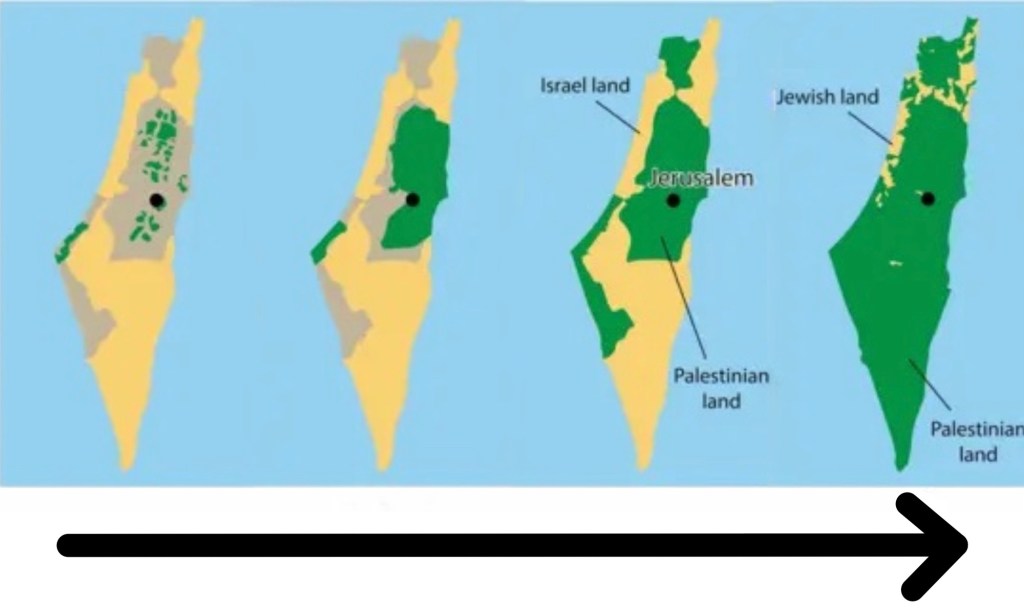
So the two-state solution is dead. Not wounded, not on life support—dead. And finally, after decades of watching the corpse get dragged through the mud, the international community is starting to mutter the words nobody wanted to say: one state with equal rights for all. A single democratic entity from the River to the Sea, where a Palestinian has the same rights as a Jew.
Cue the panic in Jerusalem.
Because here’s the thing about equal rights in a single state: it’s a demographic death sentence for the Zionist project, which was never about a safe haven for Jews—it was about enforcing a Jewish demographic majority, period. As scholars have noted, the Zionist movement treated the indigenous Palestinian population as an “existential obstacle” from the start. Theodor Herzl himself wrote in 1895 about doing the deed “quietly and carefully”. The 1948 Nakba expelled 750,000 people and flipped the demographic script from 30% Jewish to 81% almost overnight.
But now? Equal rights means the demographic math that Israel has spent 75 years fixing through ethnic cleansing comes roaring back. And they know it.
The New Math: Shrink the Problem Before the Solution Arrives
So how do you beat a one-state solution with equal rights? Simple. You just make sure that when it finally arrives, there are as few Palestinians left as possible to enjoy it. You create an apartheid system and then you shrink the minority population down to a manageable size—like Israeli Arabs, who have been reduced to 20% within the Green Line and are still structurally discriminated against.
The Strategy: Make Life So Unbearable That Leaving Seems Like a Good Idea
This isn’t speculation. We’re watching it happen in real-time.
Jenin. January 2025. Israeli forces roll in with Apache helicopters, drones, and bulldozers. They don’t just raid the refugee camp—they expel 32,000 people. They demolish over 850 homes. They create “access routes” by flattening entire city blocks. And then? They don’t let anyone come back. Human Rights Watch called it ethnic cleansing. War crimes. Crimes against humanity .
Gaza. As if the holocaust of our time isn’t enough, over 1.9 million Palestinians have been forcibly displaced since October 2023. The UN Commission found that Israel has destroyed 75% of the Gaza Strip, creating “buffer zones” and “corridors” that effectively shrink the territory available to Palestinians down to almost nothing. They’ve destroyed infrastructure, bulldozed civilian buildings, and inflicted “conditions of life calculated to destroy, in whole or in part, the Palestinians in Gaza”. That’s not a war crime. That’s the literal definition of genocide, according to the UN .
The West Bank. Demolition orders. Checkpoints. Settlements. Land confiscation. Settler violence. Over 2,300 arrests just in the Jenin and Tulkarm governorates in a single year, accompanied by systematic destruction of homes, torture, and “colonial erasure operations”. The UN Commission found that Israeli policies demonstrate “clear intent to forcibly transfer Palestinians, expand Israeli Jewish civilian presence and annex the entirety of the West Bank” .
And the beat goes on. Destroying orchards. Killing cattle. Withholding Palestinian tax money. Impoverishing entire regions. Making sure that for a Palestinian, staying in Palestine means watching your future die one settlement expansion, one home demolition, one check-point humiliation at a time.
The Billionaire’s Buyout: Why Western and Arab Governments Just Watch
Now, about those governments watching this and doing exactly nothing.
You know how Trump just openly admitted on the floor of the Israeli parliament that he moved the U.S. embassy to Jerusalem and recognized the Golan Heights because Miriam Adelson—an Israeli-American billionaire with “$60 billion in the bank”—came to the White House and “got me thinking” about it? He even said, “I know you love Israel. What do you love more? The United States or Israel?” and when she refused to answer, he just laughed it off.
Let that sink in. The President of the United States, on foreign soil, publicly admitting that he’s taking foreign policy direction from an Israeli oligarch who donated over $424 million to his campaigns . If that were a Russian, it would be the biggest scandal in American history. But because it’s Israel, it’s just Tuesday.
And let’s not pretend the Arab regimes are innocent bystanders in this grotesque pageant. From Cairo to Riyadh to Amman, the so-called “guardians of the Palestinian cause” have been sitting on their hands—or worse, actively colluding—while Israel methodically carves up what’s left of Palestine. The Abraham Accords weren’t peace deals; they were permission slips. Normalization gave Israel diplomatic cover to accelerate settlements, expand annexation, and tighten the siege on Gaza, all while Arab leaders pocketed American weapons deals and Saudi investment promises.
These governments watch the ethnic cleansing unfold, issue a few anodyne statements about “concern,” and then go back to counting their petrodollars. They know that a real Palestinian state with actual sovereignty would threaten their own autocratic thrones. So they do nothing. They enable everything. And when the history of this catastrophe is written, their names will be etched right alongside the architects of the occupation—not as victims, but as accessories.
But now these Western and Arab governments are caught between two options:
Option 1: Force Israel to grant equal rights and end the Jewish-majority state. Which means facing the wrath of Zionist billionaires and the entire U.S.-Israel political machine, not to mention the possibility that Israel, cornered and desperate, might just “take the world down with it” using the weapons of mass destruction they definitely have.
Option 2: Sit back. Let Israel push as many Palestinians out as they can. Then, when the remaining Palestinian minority is small enough, Israel can grant them “equal rights” in a state that’s still 80% Jewish, and the international community can pat themselves on the back for “solving” the problem.
Which option do you think they’re choosing?
The Clock is Ticking
This is the shell game we’re watching. Palestinians aren’t leaving because they want to. They’re leaving because Israel is making sure they have no future there. The displacement is structural, embedded in legal, political, and spatial systems—not isolated events. The genocidal dimension isn’t always direct mass killings; it unfolds through “long-term structural mechanisms aimed at erasing Indigenous identity, cultural autonomy, and political agency” .
But here’s the thing about a shell game: you have to keep watching the cups.
The goal for Palestinian rights activists has to be exactly the opposite of what Israel wants. We need to keep calling for equal rights for all Palestinians, including refugees, and never stop the pressure until it’s achieved. More importantly, the political candidates we choose must publicly express this demand during their campaigns. Because the moment the international community stops calling for justice and settles for “please be nice to the Palestinians,” the demographic clock keeps ticking, and Israel wins.
And if our political class isn’t cooperating, we must reclaim our power to circumvent politicians and punish Israel directly through boycotts and sanctions with the stated goal being an end to Zionist ideology and a return to a fully inclusive, equal rights state of historic Palestine.
Palestinians have been paying the ultimate price for decades because the international community stopped demanding justice and started begging for mercy. Those days are over.
What was done in South Africa can be done in Palestine . The apartheid regime fell not because the international community asked nicely, but because they demanded equality. That’s the lesson. And if we forget it, we’re complicit in the scheme.
Trying to stop Israel means losing. We need to reverse it.
Let’s dispense with the linguistic gymnastics right now. When we talk about “settlers” terrorizing Palestinians in the West Bank, we are playing a game of semantic peekaboo that helps no one but the perpetrators. There is no difference between the state of Israel and the armed yahoos with M16s stealing olive groves, except in the minds of those who desperately need to see one. If you are armed by Israel, protected by the IDF, handed illegally expropriated land by the state, and shielded by the military while you kick families out of their ancestral homes, you are not a fringe actor. You are the Israeli government in a hoodie. It doesn’t take a geopolitical genius to figure that one out.
But here is where our collective brain short-circuits. The global response—heck, even the response from many Palestinians—suffers from a terminal case of the “Just Stops.” You know the refrain: Israel just needs to stop. Stop stealing. Stop bombing. Staahp. As if this is a toddler swatting a sibling, and a firm “No” will sort it all out. Look at towns like Mesafir Yatta. The villagers there don’t dream of justice anymore; they dream of a pause. They just want the settlers to quit trying to nick their homes today.
As if quitting now would end anything. As if Israel ever gives up land without taking two miles first, giving back one amid global applause, and keeping the other forever. Then rinse. Then repeat. And we—the international press, the U.N., the armies of armchair activists—fall for it every darned time, celebrating like we won the Super Bowl because we managed to “stop” the bulldozer this week, and thinking that taking anything back from Israel is completely out of reach.
Here is the uncomfortable reality: Israel’s entire existence, from the jump, has been expansionist. It’s not a land-grab; it’s a land-drip. They move as slowly as they must, or as fast as opportunity permits. They are in it for the long haul. Slow growth doesn’t bother them—they have the patience of geological formations. But slow doesn’t mean benign. It just means they’re playing chess while we’re playing whack-a-mole.
Why hasn’t the world given Israel the response it deserves? Because we are conditioned to react to the knife. The dramatic lunge. The clear and present danger. But what if the assailant isn’t charging with a machete, but is sneaking up with a syringe? One prick at a time. A lull, a ceasefire, a few breaks to let the wound heal—and then another prick. Same amount of blood at the end of the hour, just fewer screams along the way.
That’s the Zionist project in a nutshell. A few big incursions, yes—the ’48 and ’67 wars, the Gaza Holocaust—but mostly it’s a thousand small cuts. A village here. A nuclear scientist in Iran there. A new zoning law in Jerusalem that just happens to evict another extended family. A sliver of a neighborhood, then another sliver. Israel takes, and when the international outcry gets too loud, it graciously gives back part of what it stole, so you feel like you won something just by forcing them to return the change. Meanwhile, they’re pocketing the whole bill.
For decades, they got away with this because they moved at a glacial pace. Slow enough to bore the news cycle. Slow enough to earn a bemused nod from the West and a lazy blink from Arab leaders, who praised Israel for being “peaceful” while it was picking pockets, simply because it wasn’t doing it with a sledgehammer.
Then came the Gaza Holocaust. That was the needle finally hitting the bone. It exposed the brutality underneath the bureaucratic sprawl. It ripped the curtain open on the decades-long project. Suddenly, everyone could see the playbook. No more blindness.
But here’s our new problem: our expectation. The bar we set for our own activism. We still just want them to stop. That is the wrong paradigm.
You don’t deal with a mobster who has been shaking down the neighborhood for fifty years by asking him to pretty-please stop collecting protection money. You don’t just tell the arsonist to put out the fire and call it a day. You go after the crook. You make him pay back every cent. You make him rebuild the houses he burned. You punish him for the terror he inflicted. A criminal state is no different from a street thug; it just has better PR.
If we cannot afford to do more than “stop” Israel, we are still losing. Not fighting back, not clawing back what was taken, is a form of defeat. Because that is precisely Israel’s playbook: Take until stopped. Give back a crumb. Wait. Take again.
Palestinians firing back at settler incursions? Commendable. But if they’re not taking back what was stolen before the last incursion, if all they’re hoping for is to keep what they have now and not take back what they had before, it’s still a loss. If the world manages to halt the genocide in Gaza—and that’s a big “if”—but Israel isn’t forced to give back the buffer zones, isn’t forced to rebuild every clinic and school, and isn’t compelled to compensate every family for every injury, that’s a loss. If we don’t force a return to the lands inside of Israel proper, we are just rearranging deck chairs on a sinking moral ship.
The only way this isn’t a defeat is if we flip the script entirely. If we work in reverse to Israel’s playbook. Because accepting the status quo, even a paused one, isn’t peace. It’s just a resting period before the next needle prick. And I, for one, am tired of being the patient.