By Collateral Damage (if Collateral Damage wrote like a person who just watched a toddler get shot and then got asked to “both sides” it)
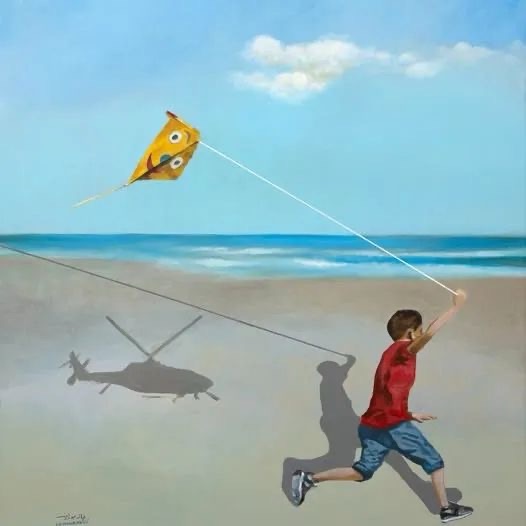
So there you are, scrolling through the usual algorithmic slurry, when you stumble upon a PBS piece about Israel banning kites in Gaza.
Kites.
Not missiles. Not rockets. Not even slingshots. Kites. The kind of thing you flew as a snot-nosed kid while your dad grilled burnt hot dogs and pretended to care about your “technique.”
Your first instinct, if you have a pulse and a shred of moral reasoning left, is: That’s monstrous. Children under siege, starving, picking through rubble for fragments of their own dead relatives, and you’re telling me they can’t fly a goddamn kite? It’s like banning laughter in a leper colony. It’s cruelty as performance art.
But PBS, being PBS—the network that once made painting with Bob Ross feel like a geopolitical negotiation—preempts your outrage with a zinger. They show you the other kites. The ones Hamas rigged with incendiary devices. The ones that drifted over the fence and turned Israeli wheat fields into barbecue pits.
And suddenly, you’re supposed to feel reasonable. You’re supposed to nod along like a juror being handed a piece of evidence that flips the whole case. Oh, you think, well, if my neighbor kept launching flaming kites at my garage, I’d probably ban kites too.
And you’d be right. In a vacuum. In a world without context. In a world where you didn’t first kick that neighbor out of his own house, take his deed, burn his olive groves, fence him into a plot of land the size of a suburban mall parking lot, starve him, bomb him every eighteen months like clockwork, and call it “mowing the lawn”—as if human beings were crabgrass.
But here’s the part PBS doesn’t say, because PBS is funded by viewers like you, and viewers like you don’t want to hear that they’re complicit in a slow-motion land grab.
The part they don’t say is this: you have no right to live where you live.
You are not a neighbor. You are a squatter with an air force. You didn’t “return” to anything; you arrived with British passports and European guilt and a theology that conveniently demanded real estate. You stole the land, built the fence, and now you’re worried about kites?
So that initial disgust you felt—the gut punch of seeing children denied a piece of string and some tissue paper—that wasn’t a bug. That was your moral compass working. That was the part of you that hasn’t been colonized by think-tank jargon and State Department press releases.
What PBS did, unintentionally, was force the question that nobody in polite company is allowed to ask aloud:
How do we let Palestinian kids fly kites without making Israelis feel unsafe?
And the answer—the one they won’t print, the one that gets you uninvited from dinner parties in Bethesda—is:
We don’t.
We stop worrying about the safety of occupiers. We stop treating “Israeli anxiety” as a variable that must be balanced against Palestinian life. We stop pretending that the guy who took your house deserves the same consideration as you do when he complains about the noise from your refugee tent.
You want safety? Let Palestinians come back home and get the full equality they deserve. If you can’t tolerate that, if equality is an existential threat to you, then go home. Not to “Judea and Samaria”—to actual home. Warsaw. Brooklyn. Morocco. Wherever your great-grandparents packed their bags before they decided that manifest destiny was a Jewish problem too.
Because here’s the paradox PBS accidentally handed us on a silver platter:
You cannot have “good Zionism.” You cannot have “ethical occupation.” You cannot have a “humane apartheid.” It’s like “healthy cigarettes” or “gentle decapitation.” The premise is the punchline.
The moment you accept that Israel has a right to exist—on that land, in that way, with that history—you are forced into a labyrinth of cognitive dissonance where banning kites becomes a reasonable defense measure, and bombing children becomes “self-defense,” and starving a million people becomes “pressure tactics.”
But the moment you reject that premise—the moment you say, “Actually, no, the land belongs to the people who were living there before the guys with the guns showed up”—the whole house of cards collapses.
And then you’re left with the only conclusion that makes sense:
Palestinian children should fly kites. Israeli settlers should pack bags. And PBS should stop pretending that showing two sides of a story is the same as telling the truth.
Because sometimes, there is only one side.
And it’s the one that’s been buried under eighty years of carefully worded press releases, congressional resolutions, and the quiet, comfortable racism of people who think “complexity” is a synonym for “don’t look too close.”
So fly your kite, kid. Fly it high.
And let the occupiers choke on the string.